Friday, June 25, 2010

Lady Liberty Art Lesson

The Statue of Liberty is a great subject for teaching art techniques; watercolor, collage, tempera, marker...pick any medium and the project will turn out great. The drawing itself is quite simple, especially if you stick to the head and shoulders. You can read my basic instructions here. For this lesson, I panned out and asked my students to draw the entire length of the statue, complete with a city scene in the background.

Supplies:
12" x 18" white paper
Black water-proof marker (Sharpie Brand is great)
Colored markers (I use Crayola Brand)
Liquid watercolor (blues and a green/black)
Optional: Embellishments such as paper scraps, sequins, etc.

Drawing Lady Liberty:

For this project, I decided against pencils and erasers. Fifth graders tend to be perfectionists and if given a pencil, will toil away for hours getting the draping just right. Of course, if you are doing this project at home and time is not a concern, go ahead, use a pencil. But in my opinion, learning to draw without an eraser is very rewarding.
I often ask my students to draw with just a marker. In order for this to work, you need to do a little work yourself. I demonstrate different ways to draw Lady Liberty on the white board. I use a marker (or course) and prove that if mistakes happen, they can be "fixed". Try this yourself and make sure that not one of your finished Lady Liberty's are perfect. The drapes on the dress, the curls in the hair and points on the crown all yield well to mistakes, so really try to instill in your students that mistakes happen and you can still have great art.
Remember to mention that if the kids run out of room, it's okay to go off the page.
Painting Lady Liberty:

Once the students complete the drawing of Lady Liberty and the background, set out a limited palette of watercolor paints. I like to combine green and black liquid watercolors to achieve the patina of the statue. If you don't have liquid watercolors, use food coloring. It works great.
Suggest that the students consider painting the statue green (they don't have to paint it all) and the water and sky. Big spaces=watercolor. Little spaces=marker.

Coloring the Details:
Once the paint is dry, pull out the markers. If you are a teacher, finishing the watercolor will allow you to manage the completion of this project better. Students who have completed the drawing and watercolor parts, can return to this project anytime to finish the coloring. Pulling out markers is much easier than prepping watercolor paint.
If you have any embellishments in your art closest, bring them out now. Some kids like to use sequins in the crown or skyscrapers. Since I have tons of painted paper scraps, I allow the students to access that as well. Some will chose to embellish, others won't.

Fifth Grade Results!


Tuesday, June 22, 2010

Blast off! Space Shuttle Art Project


"Wow! America!" by Robert Neubecker is one of my favorite resources for art lessons. I love his dynamic illustrations. This picture book inspired this Space Shuttle lesson.

What you'll need:
12" x 18" orange, blue, black or yellow construction paper
12" x 18" white drawing paper
Pencil
Black, light blue, dark blue, gray, orange, white and yellow tempera paint.
Glue and scissors


Step One: Drawing the Space Shuttle
The Space Shuttle is fun to draw. Watch all the boy's faces as they walk into the art room and glance upon the white board. You'll have a receptive audience very quickly with this project!

I like to put a few samples on the board. One drawing of the space shuttle by itself, one of the painted background and one finished project. I typically don't put a finished project on the board, feeling that it intimidates and affluences their art choices, but in this case I wanted to show how the project was two parts, not just one.

To draw the Shuttle (here is a good reference drawing) start with the white paper and a pencil. Put an outstretched hand on the top half on the paper (little finger touching the top edge). Where the thumb is, draw a dot. This will be the tip of the shuttle or the nosecone. Draw a curved line down from the dot on one side and then the other. Connect the two curved lines with a straight line. Add a skinny rectangle vertically. To make the wings, draw triangles on either side of the engine body. Next, draw the big rocket thruster behind the shuttle then add the two booster rockets.
Vary this drawing to however it suits you. I used Neubecker's illustration to guide me, but other Space Shuttle images will give you different looks.
Once the drawing is done, paint the insides of the shuttle with the different paint colors.

Step Two: Painting the Background
Again, I used Neubecker's illustrations as my guideline. You might want to create a different background. Dip paint brushes into white, orange and yellow paint and create swirling motions with the arms. The kid's loved this part of the project. I didn't limit them to how vapor and steam should look. I just explained how hot it must be to propel the rocket so high up into the air.

Step Three: Putting it all together
Set aside the background and cut out the space shuttle. Glue shuttle to background. Using a small brush dipped in black tempera paint, outline all lines. The pencil lines will be hidden underneath the paint, so explain to the kids that they are to re-draw the shuttle. Keep the teacher sample on the board so they can refer to it.


Kinder Results!

Thursday, June 17, 2010

Canvas Summer Painting Project


My daughter and I embarked on a lovely afternoon of painting canvases...check out our efforts at my Writing and Art Blog, Capturing Joy. Don't you just love the colors?

Wednesday, June 16, 2010

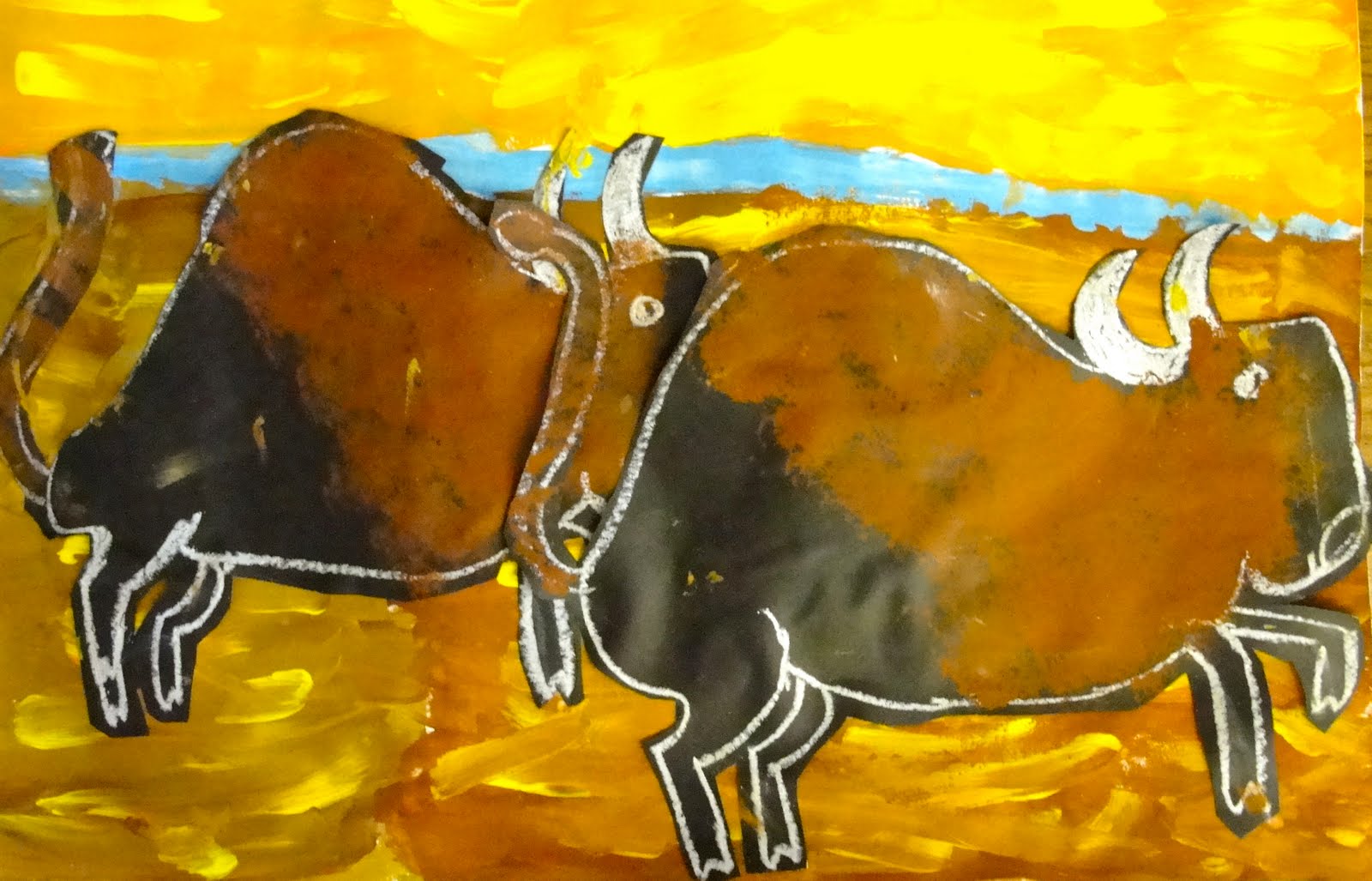
Buffalo Painting Art Project

Sometimes it takes a while for an inspiration to hit. I've had a calendar in my art stacks for about five years now. Paintings of the American West. The paintings depict the lives of Native Americans, complete with beautiful sunsets, buffalo hunts and vast plains. As part of my unit on Native American Costumes, Customs and Culture, this "buffalo hunt" was a huge success with my 2nd grade students.
We talked about buffalo and bison and the misnomers surrounding the names. Check out this website for surprising facts! I directed them through the series of selected paintings detailing "hunts" and spoke about the colors and shapes in the paintings.


What you'll need for the Buffalo...
  • 12" x 18" black drawing paper
  • White oil pastel
  • Small sponge
  • Brown tempera paint
  • scissors and glue
For the Background...
  • 12" x 18" white drawing paper
  • Earth colored tempera paints
  • Sky colored tempera paints
  • Brushes
Step One: Drawing the Bison

Demonstrate a simple drawing of a bison. Remember to point out the very big head and rather small legs! Here is a good drawing to print out for reference. Using a white oil pastel, I like to begin at one end of the black paper and draw the eye. Then, draw one tusk, the big forehead and then the back. Make sure the shoulder goes up and up (think hunchback) and curve downwards for a small butt. Add legs and other details.
Using a small sponge and some brown tempera paint, dab the paint around the shoulder and head area.

Step Two: Cutting out the Bison

After the paint dries, cut along the white line of the bison. Some kids made smaller bison and had extra room on their black paper for another bison. Draw and paint as many as you would like.

Step Three: Painting the Background
Using a palette of sky and earth colors (encourage mixing here), make a line across the length of the page. The sky will be above this line and the earth will be below. Using the calendar photographs as inspiration, the kids created their own landscape. Some used browns, oranges and yellows while others used traditional blues and greens. Whatever choice they make is fine. After the paint dries, glue on the bison.


Second Grade Results!

Friday, June 11, 2010

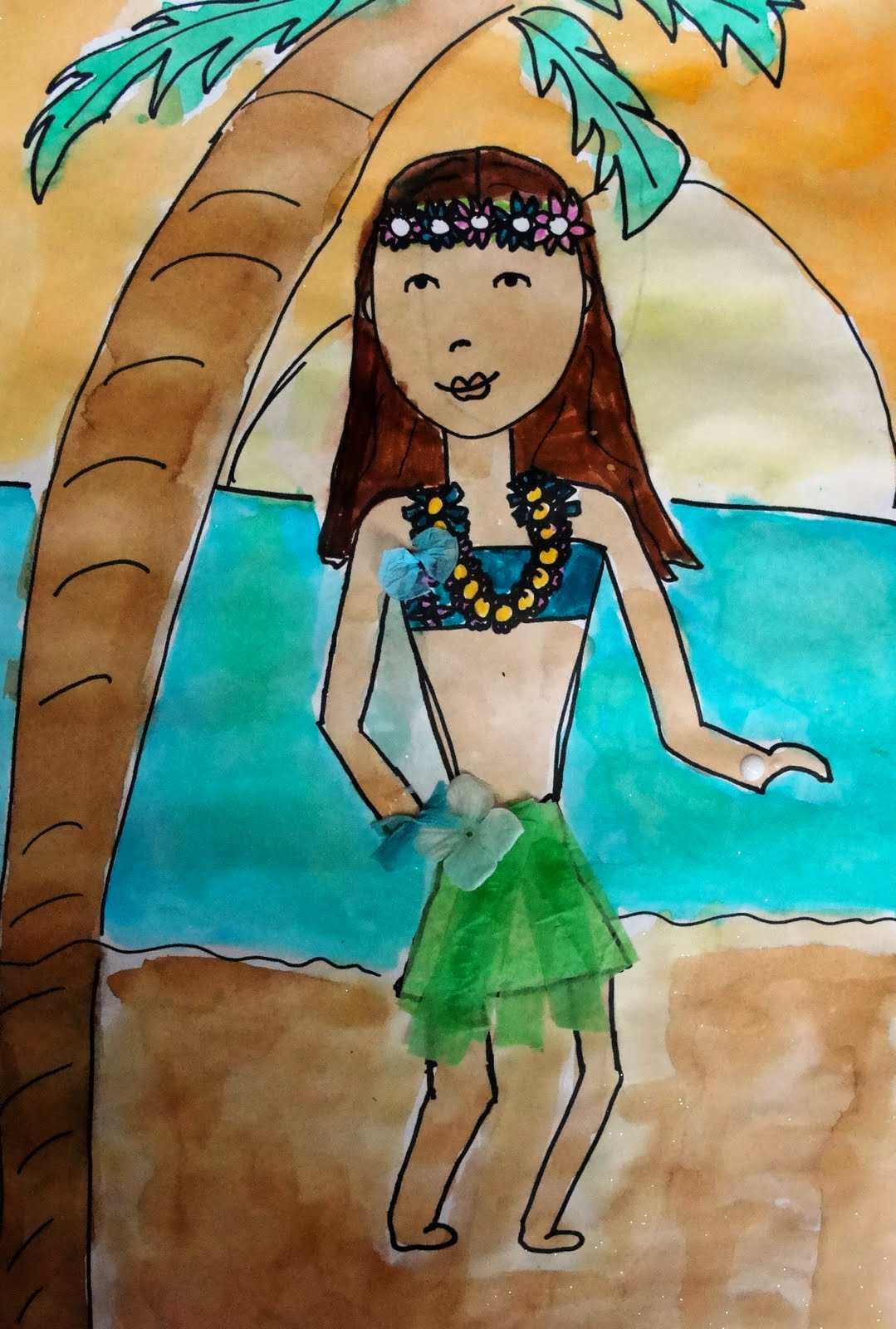
Hawaiian Dancers Art Project

Last fall my husband and I went to Maui. It was stunning; the art, food, music, beaches...all beautiful and inspiring. I vowed to use some of my memories to create an art project for my students. This was one of them...

What you'll need:
12" x 18" white drawing paper (or watercolor paper if you have it)
Black water-proof marker (I use Sharpie brand)
Watercolor paints (I use liquid watercolors but pan watercolors are fine)
Colored markers
Tissue paper
*Optional Small silk flowers, leaves or decorations


Drawing the Dancers...

The steps for drawing the dancers are varied, depending on how you like to draw. For me starting with a letter "U" about a hands length down from the top of the paper works best. Some kids will draw this letter large and some will draw it small. The resulting figures will be based on whatever size created, so make sure you reinforce the notion that all sizes are just fine.
I leave the face and draw the neck. After the neck, draw shoulders. I emphasize that the male dancers have broad shoulders and the female dancers have small shoulders. Next comes a trick I learned as a fashion illustrator. It brought about a few laughs but basically it gets the job done. Just below the shoulders, add two dots (one below the left shoulder and one below the right). So you can see why the giggles, but these dots are guidelines for the torso.
From those two "dots", draw a line, slanting inwards, to create a waist. Again, for the female the slant is more exaggerated, for the male, not so much.
Now that we have shoulders and a torso, its safe to draw arms. I give a few options here, so you might want to do the same.

Female Dancer
After the arms, draw a skirt or in the case of the male, a sash. Draw the legs and then go back and draw a headpiece first then the hair. Facial features are next and then the background.
I put up a few Tropical scenes to give the children ideas, but basically they knew what they wanted.
Male Dancer

After the drawings are complete, use markers to color in any small areas. It doesn't make sense to color in large areas with markers, as painting with watercolors is a better choice.

Hand out pans of watercolor paint. I had a few bottles of glitter watercolor paint and it worked really well with this lesson. The sparkling yellow made the sunset glimmer and the sparkly blue was perfect for the ocean.


The final step is to add embellishments such as tissue paper to the skirts, beads or flowers to the hair, etc. Some kids chose not to add anything, which was fine.

Fourth Grade Results!

Related Posts Widget for Blogs by LinkWithin