Sunday, February 28, 2010

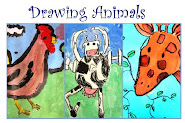
New! "Drawing Animals" PDF Art Booklet

You asked for it! An art lesson featuring animals was my number one requested lesson according to your emails and Facebook requests. (Cultural Lessons was number two and will be available in a couple of weeks!)

This 17-page PDF Art Booklet features three kid-pleasing lessons with a bonus lesson included. Perfect for Kinder all the way to sixth grade, these lessons include how-to-draw handouts, complete photo-tutorials and the ever popular student gallery.

Dancing Cows is inspired by the famous "Cows" Creamery in Prince Edward Island, Canada (where I grew up!). The business has a staff of artists who create funky cows images for their private label t-shirts. I couldn't help come up with a lesson inspired by one of their images. Children will LOVE drawing an upside-down or a ballerina cow!

Speckled Hens combines a realistic painting with a folk art background. Upper elementary is suggested but this lesson can be adapted for younger students as well. Follow my step-by-step guide for drawing a hen and paint away using a cool double-loading technique. You'll want to frame one of these!

Giraffes are a staple in any art room and for good reason. They're easy to identify with their beautiful necks and gorgeous spots which makes drawing them effortless to draw! As a twist, this lesson focuses on the head and neck...no tangle of legs necessary!

The PDF is designed to be printed out or you can read it directly from your computer screen. Please note, that the lesson will NOT be mailed or emailed to you.

Click on the button below to purchase:


Only $5!


Friday, February 26, 2010

Sock Monkey Art Lesson

Aren't these the most adorable things you've ever seen? I spotted a Sock Monkey Calendar at Border's bookstore and knew the colorful photographs would make an outstanding art lesson. I mean who doesn't like these nostalgic toys? The lesson is easy and introduces a new technique for my students: paint scratching. The collage aspect of this lesson fills the much needed desire for kids to cut, paste and create.

Supplies:
  • 12 x 18" colored Tru-Ray Sulphite paper (construction paper)
  • Black oil pastel
  • Palette of brown, white and red tempera paint
  • colored yarn, ric-rac, pom-poms, googly eyes, painted paper or paper scraps, buttons...anything decorative!
Step One: Drawing the Monkey
I use a directed line drawing approach to this art lesson figuring it never hurts to have a good base for all the decorative fun that's coming in step three! No need for elaborate instructions as you can see the drawing is quite easy:
  1. Draw two dots for eyes
  2. below the "eyes" draw a large ovals on its side. Then draw another larger oval around that. Add a line in the middle for the mouth.
  3. Starting at the outside oval on the left hand side, draw a line up and around to the other side of the oval. This will become the head.
  4. Draw a curved line at the top of the head to mimic toe reinforcements.
  5. Add two ears to the side of the head.
  6. Draw a simple body and skinny arms.
Step Two: Painting the "reinforcements"
Using white tempera paint (do not wet brushes), paint the mouth and the top of the head with white paint. Let dry slightly and then paint over the white area with brown or black paint. The paint in this picture looks purple, huh? It's really brown.Turn the brush around and with the tip, scratch lines away to mimic ribbing. Tip: Do not let brown paint dry. It's critical that the wet brown paint slide right over the dried white paint. Kids love this part!
Finish painting the body with brown or even gray paint (use the double-load technique with the black and white paint).
Then, use an oil pastel to trace over all painted black lines.

I love how this student used strands of yarn to create his own pom-poms. The picture on the right shows some great eye detail.

Step Three: Decorate your Sock Monkey
Set out tray fulls of embellishments and demonstrate a few easy ways to decorate the sock monkey. I show options for eyes, show how to cut a piece of paper to fit the head and even make simple pom-poms.
This is truly the best part of the lesson. Kids enjoy the process of experimenting and coming up with the most unique monkey. Third Grade Results!

Sunday, February 14, 2010

Cardinals in Winter Art Lesson

I believe this idea originated from the fabulous Painted Paper Flicker Stream, although it may have come from a link. I'm terrible at organizing my bookmarks, so I apologize to the creator of this beautiful lesson. My second and third graders did this lesson, but it would be appropriate for fourth grade as well. It's very easy considering how stunning it is. I didn't create a handout for this lesson because you really don't need one; just a quick demonstration on the whiteboard is enough to get the kids drawing.

Supplies:
  • 12" x 18" white paper
  • Blue metallic tempera paint (Michael's craft store will have this paint)
  • Pencil
  • Black, red, yellow and white tempera paint
  • Q-tips for snow

This is the picture I used sourced from the internet as an example of a cardinal. Explain however, that it's not necessary to draw the entire body, just the head and neck area.
After drawing the bird in pencil (yes, pencil! No eraser though), draw branches and lines for twigs. Set out the metallic blue paint and paint the background first.
After painting the blue background, paint the red cardinal, then the yellow beak, brown twigs and then finally, the black mask and outline. Final step: snowflakes using a q-tip dipped in white paint.
Second and Third Grade Results!

Friday, February 12, 2010

Dr. Seuss Day "One Fish Two Fish" Art Project

Here is a great Dr. Seuss Day art project for your little ones. Inspired by my favorite "One Fish Two Fish", this lesson is perfect for any lower elementary grade including Kinders.

Supplies:
  • 2 @ 12" x 18" white paper
  • black oil pastel
  • blue, yellow, green and red tempera paint
  • glitter
The younger the student, the more time you'll need talking/demonstrating eye placement. I like to have the kids point to where the eye should go and then when they get a thumbs-up from me, they are free to draw a black dot. Here's my thinking: Since we're working with oil pastel (which the children can't erase) you want to make certain they leave ample room to draw the body or else the fish might be small.
Starting at the far left (if they chose a swimming fish) or near the top (standing fish) gives the children plenty of space to draw the body.
Whew! That was long, huh? It's important though.

To draw the fish: I read the first few pages of the book and point out the different fish illustrations, then on the white board, I draw two styles of fish: one swimming across the paper (horizontal) and one standing up (vertical). I do a directed line drawing for both.
I don't have a handout, but here are the steps:
  • Draw two dots for eyes for standing fish or one dot for swimming
  • Add a circle around the eye(s) and add eyelashes if you wish
  • Standing:Draw a curved line over the top of the eyes and move the line all the way down the paper and curve up like a letter "J" . Then, draw a similar line on the opposite side and join together at the tail.
  • Swimming: starting in front of the eye, move the pastel along the top of the paper to form an arch, then make another line starting at the eye draw a line around the bottom of the paper towards the tail. Both lines can be wiggly or curved. Whatever you like!
  • For the standing fish make fins and add lines inside the body for scales. Do the same for the swimming fish and add a funny looking tail.
Pretty basic instructions, but if you look at the kids drawing you'll see that any shape will do. Just have fun!

Now that the drawing is done, set out some paints (limit the colors so you don't end up with mud) and paint the fish.
After the fish dries, trace over the oil pastel lines with black and add some patterns with other colors of oil pastel if you wish.
Cut out the fish. This is a great project for practicing cutting skills!
Now, take the other white paper and paint stripes from one side to the other.


If you wish, you can glam up your Dr. Seuss art project by adding some glitter. While the stripes are still wet, sprinkle with glitter and shake excess off into a big tub.


Finally, glue fish to background!

Kinder Results!
Related Posts Widget for Blogs by LinkWithin