Wednesday, January 28, 2009

How to Draw a Castle

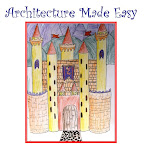
This lesson has been quite rewarding for my fourth grade classes. Looking at a pictures of detailed castles, with bricks, battlements, turrets and doors can be overwhelming, especially if you are expected to draw one.
I found the perfect solution. Borrowing a tip from my How To Draw a Barn lesson, I cut small and long rectangular shapes from tag board. These provide the perfect template for the center section of the castle. After tracing the center, the kids used a long templates to trace the two towers. This method is quick, accurate and eliminates the measuring and stress associated with creating the perfect lines. I demonstrated various decorative techniques varying in skill level from easy to more difficult. Many kids chose the difficult elements and felt quite proud of their accomplishments.
The first step was to pencil in all of the pencil lines, then we outlined the castle in black marker. This is the stage when I showed the kids how to add bricks. they loved how the bricks 'aged' the castle.
Finally (and this is the step that really takes the longest) is to color in the castle and background using colored pencils. If you have high quality colored pencils, the projects will turn out well. The color pencils used in this lessons were not so great, so the saturation was slightly weaker than I had hoped. Still, a wonderful project that the kids are super proud of.


To make life easier for you, I have developed a down-loadable lesson plan that features this "Castle" lesson. The PDF includes the measurements for templates and full photo tutorials. The PDF also includes two other lessons using templates as tools. Click on the "Buy Now" button below to purchase or go back HERE to see more details.

"Architecture Made Easy" Lesson Plan Booklet $5


Monday, January 26, 2009

City at Night: Paper and Scissor Lesson for Kinders

Here is another great lesson for kindergartners to practice their cutting and pasting skills.


Supplies Needed:


Scissors & glue stick per student Construction paper in various colors cut into rectangles 1 12" x 18" black paper per student white tempera paint mixed w/water 1 small stiff brushes per student

Instructions:

Step One: Creating the moon and stars.
Show the students how to create a moon by swirling the small brush in a circle and splattering the white paint to create the stars. This step takes about five minutes. Set black paper aside.

Step Two: Creating the skyscrapers.
After a short discussion on what a skyscraper is, I show the kids how they can take a rectangle and cut the top part to create a custom skyscrapers. It's a simple as cutting out small squares and rectangles from the top and sides of each piece.
Have the students glue the skyscrapers as they go, going from one side of the paper to the next.

Step Three: Adding the windows and doors.
I cut strips of yellow construction paper the width of their windows and give a couple of strips to each student. They can cut the strips into small rectangles and glue them to the windows. Same for the doors.

The kids LOVE being skyscraper builders!


Thursday, January 22, 2009

Winter Scene: Drawing and Painting lesson

Looking for an easy drawing and painting lesson with a high success rate? Try this one. Even in California, most kids equate January with cold weather. I talk about how snowflakes flutter down from the sky and land in the folds of trees, forming clumps of snow. In first grade, we stick to the lovely aspects of snow. I don't mention how hard it is to dig out from under five feet of compacted snow. To prove that snow is indeed lovely, I have lots of beautiful calendar pictures of hand.


For each student, you will need:
  • 1 sheet of 12" x 18" blue construction paper
  • 1 black oil pastel and 1 brown oil pastel
  • shared tray of watered down (just a bit) of white tempera paint and brushes
  • small container of red tempera paint (shared)
Instructions:

Drawing the tree. I discuss how the trunk is thick on the bottom and as the tree grows and gets higher, the branches get small and thinner. I encourage the kids to think of the tree as an upside down "Y". I demonstrate how to add branches with the oil pastel, concentrating on making the branches narrower as they grow away from the trunk.
Next, have the student's create "bark" by using either the black or brown oil pastel.

Adding the snow. With a small paintbrush, have the students paint big swathes of white paint across the bottom of the paper, going right over the tree trunk. The kids can go up as high as they want, making sure that at least half of the tree is exposed. Next, have the student's paint small clumps of "snow" in the pockets of the tree branches.

Adding a red highlight. I ask the kids to paint something red on their picture. It could be a scarf for a snowman, a red fox, a cardinal, whatever they want. I resist the urge to show them a sample, because this tends to sway them into what to paint. Have the kids use their imaginations as much as possible. Although, if Ashley draws a fox, you can bet the girl next to her will as well. That's just the way it goes!

Now for the FUN part...adding snowflakes. My technique for splatter painting is to use a medium sized brush, dipped in white paint. Then, holding it about 2" above the painting, tap with a finger. Many art teachers use toothbrushes, but I find the spray is too small and can be difficult for little fingers to manage.
Just a big dollop of white paint and a good tap should yield enough snowflakes to satisfy first graders.


Tuesday, January 20, 2009

Modigliani Inspired Self-Portraits

I found this lesson over at Art Project for Kids. It's a fantastic lesson; easy, quick and beautiful. I chose to do this with my 6th grade students but it would be equally successful with as young as fourth grade. Check out the link above for full directions.


For more portrait lesson ideas, check out Deep Space Sparkle's "Fun with Portraits" PDF booklet. Click HERE for more details.

Thursday, January 15, 2009

Helpful tips #1 Setting Up Painting Projects and Making them Look Good!

Inspired by a recent comment from Sarah S, I thought I'd address a few concerns that some teachers face when teaching art to their students.
Sarah commented that when she painted with her students, the projects never really seemed to "turn out". I know exactly what she means. Perusing art pages and seeing countless beautiful works from little bitty kids makes me wonder too, how the heck did they do that? First of all, it can be done, BUT it takes a bit of organization and a few fail-safe techniques. Here are my secrets....

Tip #1 Making the Art look
"Picture Perfect".
Okay. So before I go any further, I want you all to know that I believe strongly in the mantra that art is about the process not the end-results. Still, it doesn't hurt to make the most out of every project.
For painting lessons with younger kids, I often use black oil pastel to trace over the lines once the paint is dry. Similarly, I used black paint for the same purpose. This simple step creates the strong contrast that is so appealing in kid's art.

Here are a few examples:


(Click on the photos to read the instructions)

How do I set up for a painting lesson?

Use plastic "muffin tins" for paints (see sidebar). These can be found in any art catalog and are quite helpful in reducing the amount of paint you use and saves time in set-up. If I have 25 students, I set out one tray for every table. That means 5 trays for 5 tables. Easy peasy.
Each child then gets a paint brush and access to two water containers. If you are in a classroom with individual desks, art set-up will be a bit tough. This is a worse case scenario if you ask me! All I can suggest is to use paper plates with small blobs (quarter size) on each plate.

What about mixing?
I get asked this all the time. I encourage my students, especially the lower grades, to mix paint onto their artwork. Yes, you read right. Kid's often get way too hung up on finding the "perfect" color and really mixing is just a waste of time. I teach the kids to "double load" their paint brush. Dip the brush into one color (say yellow) then dip straight away into another (say blue). Now, the paintbrush has two colors on the bristles. The kids love smearing the brush along the paper and seeing the colors mix by themselves. A bit of art magic.
Of course, this only applies to lessons when the paint colors are up to them. For a lesson teaching color mixing like my Colorwheel Clowns, I use plastic or paper plates.

Tuesday, January 13, 2009

Kindergarteners do Kandinsky!

This is a terrific lesson to teach the fundamentals of kindergarten curriculum basics:
Cutting and Pasting!
I discovered this lesson over at the Artsonia website. Camelback Desert School in Arizona provided the original lesson of which I altered very little. The kids are literally tracing, cutting and gluing. There is nothing else involved and what good practice it is.

Instructions:
Hand out a sheet of black construction paper.
Tip: If you have only a little time to do this project, cons
ider making the paper size small than the regular 12" x 18". It'll go much faster and the effect will be the same.
Despite the lesson being quite easy, the set-up requires a bit of time. Every student needs a glue stick, pair of scissors & pencil. Easy. But to reduce the amount of paper waste with this project(we all know that the kids will cut the tiniest circle from the middle of the largest piece of paper), you'll need to provide paper in stages.
Here's what I did: Give each student a plastic container with a 5" diameter (yoghurt, salsa, sour cream containers), then have them trace and cut out 6 circles. Provide paper that is just the size for the container. Glue the cicrcles onto the black paper.

Next step: Do the same but use a small plastic cup and smaller pieces of paper. Have them cut out 6 medium sized circles. Glue the medium circles to the large circles. Tip: talk about contrasting colors or else you'll have the yellow medium circles glued to yellow large circles. I suspect for this age it's all about matching things up!
Repeat steps, but this time, the kids can use the scraps of paper from steps one and two to make smaller and smaller circles.
Good luck!

Tuesday, January 6, 2009

Colorwheel Clown Art Project:

I wish I could remember the website where I found this lesson! It's one of my favorite kinder lessons that incorporates a color wheel. This lesson is a bit involved. It usually takes three 30-minute classes to complete this project but it's worth it.

You'll need the following:
  • white card stock with a color wheel pattern (I made mine by tracing the bottom of a container and adding the lines).
  • Plain white card stock (for the head)
  • small pieces of leftover construction paper in a variety of colors.
  • 12" x 18" colored construction paper for each child.
  • glue sticks
  • Red, yellow and blue tempera paint
  • pencil, scissors and a plastic cup for each child

Step One: Making the color wheel.

Pass out a blank color wheel to each child. Each child should have their own paper plate with a small dab of yellow, red and blue paint, a small paint brush and a container of water to share.
Instruct the children to paint one "pizza" slice yellow, then red, then blue. Next, ask the children to paint a slice orange. They'll tell you that they don't have any orange paint so you'll show them how. Do the same for purple and green. Set the colorwheels to teh side to dry.

Next, have the children trace the opening of the plastic cup onto the blank piece of paper. This will later be the face. If there is time, cut out the face.


Step Two
: Adding facial features with paper

Now that the color wheel is dry, the children can cut around the edges. Glue the face and color wheel (belly) to the colored sheet of construction paper. Make sure to glue the head first and demonstrate the proper place to glue it.

Once the face and belly are in place, the kids can use the small bits of colored paper to add eyes, a nose, a mouth and even hair to their clown's face.

Step Three: Painting the clown's outfit
Using tempera paints, paint hair, arms, dress, pants, clown shoes, etc. on construction paper. Encourage patterns like polka dots and stripes.

Note: If the length of your class runs longer than 30 minutes you can probably complete this lesson in two sessions not three.
Related Posts Widget for Blogs by LinkWithin